

Lentiviral vectors are important tools in gene engineering and gene therapy. The vectors are encapsulated within viral proteins to form particles that can transduce targeted cells in vivo.
I’m often asked about Esobiotec’s ESO-T01 in vivo CAR T-cell clinical study in multiple myeloma. The published safety and efficacy data are complicated and have raised questions about lentiviral particles as a viable delivery option. In the meantime, emerging data from other studies suggests that the ESO-T01 results do not reflect broad technology risk. Results from Kelonia and Legend Biotech are particularly interesting. I’d add that my expectation is that Astra Zeneca, who acquired Esobiotec, is well-positioned to derisk that platform and move the technology forward.
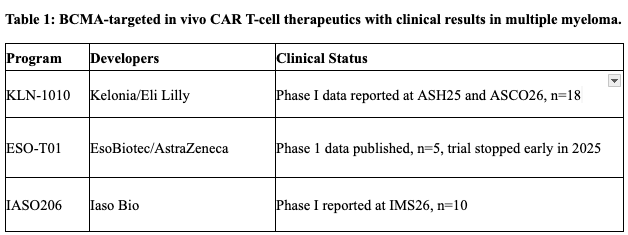
Clinical results from in vivo BCMA-CAR T studies in multiple myeloma.
For a quick overview of the emerging data we can focus first on the multiple myeloma space using results from 3 different companies:
EsoBiotec/AZ
To understand the issues it is helpful to dissect the ESO-T01 study and the results¹⁻³. EsoBiotec’s ESO-T01 was the first in vivo BCMA CAR-T candidate to reach the clinic, via an Investigator-Initiated Phase 1 Clinical Trial in China. The vector used was a third-generation, self-inactivating lentiviral vector with several interesting features designed to limit off-target effects and to shield the viral vector particles from recognition by the patient immune system.
Design features:
T-cell targeting to preferentially bind to and infect circulating CD3+ T cells.
T-cell-specific promoter to restrict expression of the BCMA-CAR payload exclusively to T cells.
Vesicular stomatitis virus glycoprotein G (VSV-G) mutation to prevent binding to LDL-R and restrict off-target binding.
Lentiviral membrane engineering to overexpress CD47 to suppress phagocytosis by the macrophages and other cells and prolong vector half-life.
Beta-2-microglobulin knock-out in the vector production cell line to eliminate MHC Class I expression and reduce elimination of the vector particles by immune cells.
It’s fair to say that these modifications were not sufficient to mask the viral particles from the immune system. The lentiviral vector partcles induced acute and immediate innate inflammation in all 5 patients. The toxicities described were similar to those caused by high doses of other viral-based gene therapies and occurred before the CAR-T cells had expanded after infusion, suggesting that the viral particles triggered the severe adverse events. A hyperacute reaction with dangerously high inflammatory cytokine expression and cardiovascular abnormalities occurred in one patient within hours of viral particle infusion triggering the use of anti-inflammatory drugs to control the immune response. Prophylactic steroid treatment was initiated for all subsequent patients.
Additional toxicities of Cytokine Release Syndrome (CRS) and Immune Effector Cell-Associated Neurotoxicity Syndrome (ICANS) occurred as the CAR T-cells expanded. Three cases were severe with patients developing high fevers, low blood pressure, and hypoxia. These are expected toxicities and were controlled by additional use of anti-inflammatory therapy. However, one patient experienced Grade 1 ICANS and acute neurological deterioration as the CAR T-cells hit peak expansion from days 10-14, with prolonged elevation of pro-inflammatory cytokines (IL-8, IL-8, IL-10). This patient died of cardiac arrest 19 days after infusion. Although the death was attributed to pre-existing extramedullary disease due to a localized myeloma compression of the spinal cord, the pattern of acute toxicities in the trial caused concern about the in vivo lentiviral technology. Nonetheless, the initial efficacy looked promising with three patients achieving stringent complete responses and one patient achieving a very good partial response. These four patients were also reported as achieving minimal residual disease (MRD) negativity, at a cutoff of 1 in 10⁵ (1 myeloma cell per 10⁵ bone marrow cells).
Of note, Q-PCR assays detected lentiviral vector DNA in peripheral blood as early as day 2, as the CAR T-cells began proliferating, but there was complete viral vector clearance by day 4. CAR T-cell numbers peaked between days 14 and 17, and were essentially gone by day 28 as measured by flow cytometry of patient’s peripheral blood. The limited presence of CAR T-cells may be a consequence of the decision not to use lymphodepleting chemotherapy prior to lentiviral vector infusion since the in vivo-generated CAR-T cells would have to survive in an environment replete with normal lymphocytes. Limited CAR T-cell persistence is generally associated with limited control of the targeted cancer, as was true in this case. Three patients were reported as relapsed or progressed between 3 and 5 months after infusion. One patient was reported as still in a sCR at 15 months post-infusion.
This study demonstrated that in vivo CAR-cell creation in patients was feasible, an important milestone. The study also triggered questions about the safety of lentiviral vector infusion and about efficacy achieved – a classic risk/benefit issue.
Studies presented from other programs have begun to address these questions – the results are preliminary but encouraging.
Kelonia/Eli Lilly
What did Lilly see that triggered this deal? The early clinical results were striking⁴. The buy-out of Kelonia by Eli Lilly came with a huge price tag, including a $3.75 Billion upfront payment (> 6x higher than the AZ/Esobiotech upfront payment). Kelonia’s lentiviral particles and genetic payload are similar in design to Esobiotec’s. Once again VSV-G was mutated to prevent LDL-R binding, and the viral particles are directed to T cells via expression of an anti-CD3 antibody domain. The CAR backbones are similar, both using 4-1BB and CD3ζ signaling. Both constructs use CD8α sequences in the hinge and transmembrane portions of the CAR sequence. One difference: Kelonia used an anti-BCMA scFv sequence for the CAR domain whereas Esobiotec used an anti-BCMA VHH. Both are high affinity binders.
Clinical doses of lentiviral particles were also similar, with Esobiotec using a flat does of 0.25 × 10⁹ transducing units (TU). Kelonia’s clinical trial was designed to evaluate 3 dose levels (4 × 10⁶ TU/kg, 6 × 10⁶ TU/kg, and 2 × 10⁷ TU/kg). Assuming an average weight of 75 kg (165 pounds) the highest dose that Kelonia could reach was 150 x 10⁷ TU = 1.5 x 10⁹ TU which would be 6-fold higher than Esobiotec’s dose. As in the Esobiotec study, no lymphodepleting chemotherapy was used.
While the doses used were comparable, the outcomes were very different. Of the 18 patients reported by Kelonia at ASCO26, none experienced induced acute and immediate innate inflammation. 16 patients developed CRS but all cases were Grade 1 or 2. Only 2 patients developed ICANS. One might assume that Kelonia’s lentiviral envelope protein engineering succeeded in creating a more “immune-silenced” viral particle. The prophylactive use of the steroid dexamethasone also likely dampened immune responses.
Efficacy results included an Objective Response Rate (ORR) of 100% with 100% MRD-negativity at one month using the 1 in 10⁵ cutoff. In six patients with four months or more of follow-up data, four achieved a stringent complete response and two achieved very good partial responses. Analysis of CAR T-cell levels in patients showed robust expansion similar to that achieved with approved ex vivo CAR T-cells. Longer clinical durability data will be needed here to properly evaluate efficacy, but these early results are promising.
IASO Biotechnology
Very much like Esobiotec, IASO used an engineered third-generation lentiviral design with a disrupted VSV-G that cannot bind to LDL-R, with CD47 expression to reduce macrophage phagocytosis and with a MHC I knockout to prevent viral vector elimination. The cell targeting domain is derived from an anti-CD7 antibody to specifically target and transduce T cells. The CAR includes an anti-BCMA VHH antibody sequence and uses 4-1BB/CD3z cytoplasmic domains.
Early clinical results showed a 90% ORR, including three stringent complete responses, and a 90% MRD-negativity rate in 10 patients given various doses of lentiviral particles⁵. ORR and MRD-negativity were 100% in the high-dose cohort. Importantly, no acute immune responses occurred, cytokine release syndrome (CRS) was limited to Grade 1-2 in eight patients, and no ICANS was reported.
The results from Kelonia and Iaso show that lentiviral particles can be safely infused into multiple myeloma patients with promising early efficacy. Moving from myeloma to B cell lymphoma brings Legend Biotech into the picture, with very interesting early data:
Clinical results from Legend’s lymphoma program.
Legend Biotech
Legend has in vivo CAR multiple myeloma programs in development, but available clinical data come from their B cell lymphoma program, LB2501, featuring dual targeting of CD19 and CD20. As with the Kelonia and Iaso programs, toxicities were minimal, with no acute immediate toxicities and CRS and ICANS at Grade 1-2.
Phase 1 data from 12 patients in 2 dose cohorts (of 3 planned) were presented at EHA26⁶. The dose response PK data are worth a quick review. Dose level 1 (DL1) enrolled 6 patients (4 at 2×10⁸ TU and 2 at 5×10⁸ TU): Viral vector cleared in 6 hours or less, CAR T-cells peaked at days 14-21 and then declined rapidly. There were no clinical responses in DL1 patients (ORR = 0%).
There were 6 patients in DL2 (all at 1×10⁹ TU). Viral vector was detectable for up to 24 hours. Remarkably, CAR T cells peaked at day 14 post-infusion and remained elevated until day 30 with modest and slow decline thereafter. CAR T-cells were detectable at day 90 in all patients and could be detected in some patients as late as day 116. The ORR = 100% and the complete response rate = 83.3% (ie. 5/6 patients). Followup was limited however, with a median of 2.3 months.
Legend’s results bear watching as the CAR-T kinetics reported are unexpected, and raise the bar for the field.
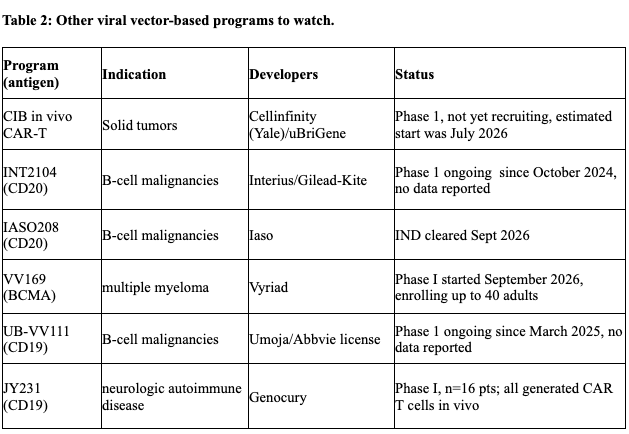
Data flow will quicken over the next months, starting with the ASH26 conference in December. Other companies to watch into 2027 are listed below.
As always, stay tuned.
References
1. Xu et al. 2025. In-vivo B-cell maturation antigen CAR T-cell therapy for relapsed or refractory multiple myeloma. Lancet. doi: 10.1016/S0140-6736(25)01030-X
2. An et al. 2026. In vivo generation of anti-BCMA CAR-T cells in relapsed or refractory multiple myeloma: a phase 1 study. Nat. Med. doi: 10.1038/s41591-026-04244-6
3. Xu et al. 2026. Extended follow-up of in vivo BCMA CAR-T therapy in relapsed/refractory multiple myeloma. Nat. Med. doi: 10.1038/s41591-026-04704-z
4. Ho, J. et al. 2026. Updated results from inMMyCAR, the ongoing first-in-human phase 1 study of KLN-1010 in patients (pts) with relapsed and refractory multiple myeloma (RRMM). J. Clin. Oncol. doi: 10.1200/JCO.2026.44.16_suppl.7509
5. An et al. 2026. First-in-Human Phase 1 Clinical Data for IASO206 in Relapsed/Refractory Multiple Myeloma (R/R MM). Presented at the 2026 International Myeloma Society (IMS) Annual Meeting
6. Qu et al. 2026. (LB5006) First-in-human trial of LB2501, an in vivo CD19/CD20 dual targeting CAR-T therapy, in relapsed/refractory B Cell NHL. Hemasphere. Link: https://s3.eu-central-1.amazonaws.com/m-anage.com.storage.eha/temp/eha26_abstract/LB5006.pdf